麻豆传媒映画

earlychildhoodeducation

End of Year Letter to 麻豆传媒映画 Families

2022-2023 School Year

To the Wonderful Families of 麻豆传媒映画 Cooperative, 

Our school year has officially come to an end. I have spent lots of time hugging teary eyed parents outside school over these last few days. Parents are joyous, proud, grateful, and in disbelief- how is it already the end? They are growing so fast! And some are asking, what will it be like now that our time at 麻豆传媒映画 is over?

Each parent and child approaches and reacts to changes differently. Some parents reported that their child was crying for weeks about not wanting school to be over. Other kids express joy and excitement about what is coming next for them. And then others seemed unphased by the changes, like they didn鈥檛 even realize what the last day of school really meant. For many kids, this is true, they may need a day or week or a month to realize that it really is over and what that means and only then will you begin to see how this change is impacting them.

The ending of this school year has me thinking a lot about expectations and what we do when our expectations are not met and how we react when something exceeds our expectations. As parents, we can鈥檛 help but have expectations of our children. Maybe you thought your child would feel sentimental and celebratory, posing for pictures outside with you but instead they were mad that you didn鈥檛 let them eat icecream for breakfast and that seems to be all they are thinking about. Maybe you thought your child would be better at sharing by this time in the year or that they would be finally out of diapers. All of these natural expectations are opportunities for us to remember that we are really just along for the ride with our kids. Even at 2, 3, and 4 years old, they are already a whole person who perceives the world and reacts to it through their own lens and experience. Many of our goals and expectations for our children reflect really positive ideas of how we want our children to grow and the type of person we hope they will become. But in reality, our children鈥檚 behaviors and reactions are less a reflection of who they will become and more a communication of what they feel in that moment and what support they need to move through the experience and build new skills. 

Our children's behavior is communication, plain and simple. But how hard for us, as parents, when those communications don鈥檛 match our adult expectations or they don鈥檛 easily draw us into relationship with our children but instead frustrate or confuse us. My advice during this big transition is: get curious. Be an observer, a commenter, and offer a reflection back to your children to help them gain awareness of how they feel and what their behavior is telling you about what they need. Rather than digging into an agenda to fix the problem (negative behavior, big feelings, regression) just notice it, try to provide language to help your child understand what you see and then let the repair happen on it鈥檚 own, I promise it will. Offer your child generosity, knowing that regressions and difficult behavior are really just their best way of telling you how they feel. Remembering this can sometimes make these moments easier to handle and the generosity will pay off when they see that you understand what鈥檚 underneath their behavior and that you are there to support them during this big change in routine. 

This practice is really my best advice in life too, not just when it comes to parenting. What do we do when the people around us don鈥檛 act the way that we expect them to? What happens when we are hurt or disappointed by each other, when we don鈥檛 feel seen or understood? Part of being in a community with other parents and being part of a cooperative school means that along with the community, connection, support, and collaboration; there will inevitably be moments of conflict, misunderstanding, and disappointment. So how do we address these instances as a school and as a community? Here is my advice: get curious and be generous. In any experience I have had over the years with a frustrated parent or a disappointed teacher, I have found that my solutions and opinions are never as helpful as my curiosity. I always want to learn more, to understand the context around someone's feelings and get clarity on their expectations. The more I can really, truly listen to the other person, the easier it is to be empathetic to their situation, even if we disagree. And generosity. I cannot say it enough. Each one of us, child and adult deserves and requires a generous spirit. When a child, parent, or teacher does or says something that surprises me, I think first of the most generous understanding I can offer them. After all we are each imperfect and each of us doing the best that we can with the skills and knowledge that we possess. At 麻豆传媒映画 I believe that our school thrives when we can each adopt these values of curiosity and generosity towards one another. 

For everyone who is returning next year, I look forward to welcoming you back with curiosity and generosity in the fall. And for those who are saying goodbye to 麻豆传媒映画, please know that we will always be your community and we welcome the chance to celebrate life with you and support you in times when you need us, so please stay in touch. I wish you all sunny summer days with your children filled with adventure, joy, curiosity, and generosity. See you again soon!

With warmth and gratitude, 
Melissa Boshans
(she/they)
Director of School, 麻豆传媒映画 Co-op

Junior Kindergarten: Spring Walk and Journal Writing

It has been such a treat to have such warm days this week. Because it was so beautiful outside, we took a walk with JK to look for signs of spring. We noticed a lot of things starting to grow. Some plants were just peeking out of the dirt and some flowers were starting to bloom. We also noticed the sunny skies, spotted a few birds and saw some other interesting things, such as a broken bicycle and a hopscotch game.

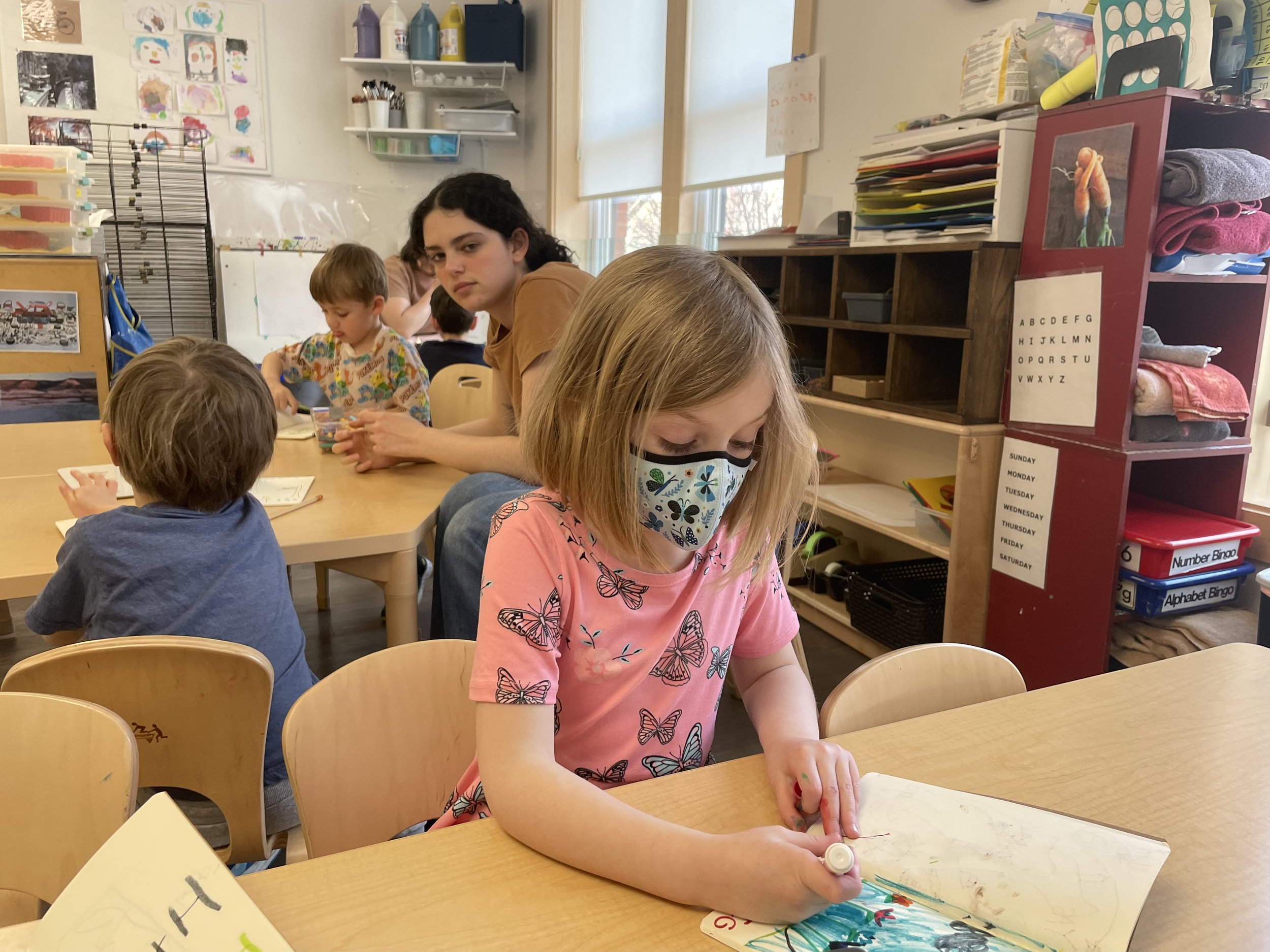
Later at tabletime, we made journal entries about what we noticed on our walk. Though many children choose to write and draw regularly at playtime, a focused journal writing activity provides an opportunity for children to reflect on a specific experience and exercise their growing literacy skills. 

Writing happens on a continuum, so we see many different forms of writing from children this age. At the beginning of the writing continuum is drawing, which can have varying degrees of complexity. In JK, most children are able to do some form of representational drawing. During this particular journal writing activity, children drew a variety of things, ranging from flowers and plants, to sunny skies, to the friend next to whom they were walking. This is what we鈥檙e looking for: children accessing their impressions and memories from our walk and putting their ideas on paper.

We include a visual of the date in case children want to add that to their drawing. As the year progresses and children have a deeper understanding of the calendar, we鈥檙e seeing more interest in replicating the date. Some choose to skip this step or write just the number while others might include a single letter or even all the letters of the day and month. This gives children practice making letter forms and more experience with these familiar words and numerals.

Once children have completed their drawings, we ask about adding words. For some children, we record their dictation, which helps to demonstrate the process of writing and build the understanding that what is spoken can also be written. Seeing their own words in print can be powerful for children.Some may prefer not to have any words with their drawings and that鈥檚 ok, too. 

First attempts at writing are reflective of each child鈥檚 understanding of it. Initially, many children make squiggles and will report what those squiggles say. With a bit more experience, these squiggles begin to look more like letters. Eventually, children start to make random letters that, to them, represent their meaning. Each of these steps represents a part of the writing continuum. It is important to both encourage each child鈥檚 efforts and affirm that they are all forms of writing. 

We often ask children to help us think about which sounds they hear in words that they want to write and encourage them to write those letters themselves. This type of writing, in which children begin to spell words phonetically, is called invented spelling. When children first begin to use invented spelling, they often start by writing just the first letter sound of a word. As they develop more experience, they might try to add more sounds that they hear, often eliminating vowels. Practice with invented spelling helps children develop the ability to both write and decode the written word.

Most children look forward to journal writing and enjoy creating a record of their thinking. It gives us insight into each child鈥檚 literacy development as well as their unique ways of approaching written work. At the end of the school year, children will bring their journals home to share with parents. In the meantime, we value sharing this experience with them in the JK classroom.

Contributed by 麻豆传媒映画 Co-op Teachers Amanda Speck and Katrina Nousaine Mann, JK-East

鈥淵ou鈥檙e not my friend!鈥� Friendship and Preschool: What it Means and What it Doesn鈥檛

鈥淵ou鈥檙e not my friend!鈥� Makes your heart sink, right? This is a common refrain in the preschool years, but it might not mean exactly the same thing to us as it does to the kids who are using it.

Developmentally, kids who are three and four have typically only just started to solidify their knowledge of the intricacies of working and playing with one other person. Negotiating and compromising, following someone else鈥檚 lead, and incorporating someone else鈥檚 ideas with your own are very big challenges. With such skills newly acquired, there is a lot of risk in trying to take them to the next level: small groups. This is one reason why we see such extreme defensiveness from some kids. They鈥檙e holding onto their relationship with the friend with whom they do feel confident taking risks and trying new ideas.

Here鈥檚 where it gets a little more complicated: kids are beginning to realize that they enjoy spending time with lots of other kids, in small groupings and in pairings. But, what do you do with that when you鈥檝e only known friendship to be a concept you share with one other person? You accept someone as your friend when you want to do something with them, but reject them as your friend when you want to spend time with someone else or alone. That鈥檚 what friendship means to many kids right now: you are my friend when I am playing with you, you are not my friend when I鈥檓 not playing with you. So, most of the time kids are not trying to be hurtful when telling someone they are not their friend. It can be a matter of misunderstanding the complexities of friendship. Kids are still building this concept, and will continue to as long as they keep coming up against interactions and ideas that challenge and expand their preconceived notions.

There are times when someone has picked up on the fact that telling someone, 鈥測ou鈥檙e not my friend,鈥� hurts their feelings, and so they use the phrase to retaliate when they feel like they鈥檝e been wronged, rather than as an exclusionary tactic. In our classes, it often happens when one鈥檚 preferred playmate is already engaged in play with another person and does not want to be joined by someone else. The one who is jealous of the relationship their preferred playmate has with someone else might tell them, 鈥測ou鈥檙e not my friend,鈥� in order to try to make them feel as bad and left out as they do. Teachers try to help tease out what is going on in every situation in order to respond appropriately, and that begins by having a conversation with the kids who are involved.

We see the conversations we have with kids about what it means to be a friend to be beneficial for each person involved. When there is a conflict, we try to slow everyone down and really get to what is at heart for each person. We try to be free from judgment and ask simple questions like, 鈥淒id you say Matt is not your friend?鈥� 鈥淵ou played with Matt in the gym today, and it looked like you were friends. Why not now?鈥� Sometimes there are clues we can pick up on: a child鈥檚 eyes following another peer while trying to work through the conversation, or an existing play scenario with another person nearby. Then, we might ask something like, 鈥淒id you want to play with Samantha right now instead of Matt?鈥� or 鈥淚s Matt having a turn to play with Jason?鈥�

Once we know what the motivation was, we can help work out a solution or compromise. 鈥淚t鈥檚 okay to tell Matt that you want to play with Samantha. Do you think you鈥檒l want to play with Matt again another time?鈥� Usually, the answer is yes, and we help work out a plan for when this will be. If not, we talk about why not. Sometimes feelings have been hurt on both sides and it鈥檚 not until we acknowledge the moments leading up to both experiences that kids can move forward.

Depending on where kids are developmentally, we might nudge someone a little more towards trying to incorporate another peer into play, but we鈥檙e not looking to move that faster than anyone is ready for. We think everyone needs time to master one-on-one play before moving into small group play. If there does seem to be malicious intent, we are clear about why this is not okay, but we still try to have a conversation about the motivations involved. Among other things, we see these conversations as opportunities for expanding emotional vocabulary, and offer new words to describe the nuanced feelings involved: 鈥渋t sounds like you are jealous that she is playing with someone else, and it鈥檚 okay to tell her that鈥� or 鈥渋t looks like you are disappointed that she doesn鈥檛 want to play with you right now.鈥�

Not everyone leaves these conversations happy. A lot of the time, someone is still hurt and has to then face the challenge of finding something else to do when they still want to be with their original choice. Teachers assist kids in this process with suggestions for other kids to be with or activities to try. And, there are times when someone is so overwhelmed by emotions that we suggest they just take a break from trying to be with someone else. We help them settle into another activity alone or with a teacher, and revisit the conversation about friendship after they鈥檝e calmed down.

Our approach looks different from child to child. As with every point of development, each person is in a slightly different place; we respect that, and try to meet everyone where they are. We will be assessing and reassessing where each child is and what we can do to scaffold their development throughout the year.

When you hear about hurt feelings at home, comfort your child, but try to have a conversation about friendship too. You can use examples from your own life as models for the complexities of friendship: you and your partner probably don鈥檛 do everything together even though you love them, and maybe you have a friend you only see a few times a year, or one friend is fun to have dinner with, but you enjoy going to a museum with another. Reassure them that if they didn鈥檛 play with the pal they hoped to one day, they might the next, and ask questions about what they did do that day. Try not to fuel their hurt with your worry. If you think we鈥檙e unaware of something that is causing your child pain and confusion, write your teachers a note and they can observe your child鈥檚 peer interactions more closely and follow-up with you.

Contributed to by 麻豆传媒映画 Co-Op teacher Amanda Speck