Âé¶¹´«Ã½Ó³»­

Ashley Chia

Happy New Year and Welcome Back to School!

As your child renews their connection to their teachers, classroom, and classmates they may need a little extra support to get back into the school routine. This doesn’t mean that they’re regressing, or that they will need another extensive separation plan.  Now that they know their classroom and teachers, they will pretty quickly reacclimate to the classroom rhythms and embrace the routines that are already familiar. 


During these first few days back, it can help if their adults do some things with and for them - even the things they already know how to do. So maybe they will need help with dressing before you leave, or want you to stand right with them at the sink to help wash hands when they arrive at school. They may shy away from teachers or kids after such a long time away. You can offer teachers your own greetings, and make some observations about the classroom to help your child find something they’ll want to play. You can be assured that teachers are ready to help your child reenter, and will offer you support as you settle them in and say goodbye. 

We all look forward to continuing the school year and beginning a new calendar year with our Âé¶¹´«Ã½Ó³»­ Community!

Best,
Anita

Adapting our Responses

Adapting our Responses

Navigating life with young children can really keep us on our toes, and requires an ability to constantly adapt and adjust. Just when we figure out the demands of our sleepy newborns, they become more alert and awake, and require a shift in the kinds of stimulation and support they require. Toddlers need a different kind of input, as do preschoolers, then primary age kids and tweens, then teens, and so on. Each stage places different demands on parents or caregivers, and requires us to always be shifting our approach to meet a child’s changing developmental needs. 

Here Come the Holidays!

Many of us will be celebrating Thanksgiving next week and some of the things I’m most grateful for are my Âé¶¹´«Ã½Ó³»­ community, and for the part each of you plays in our Co-op. As the days grow colder and darker, it’s nice to take a moment to think of the light you all bring to our school. Your children brighten our days, with their lively ideas and fresh outlooks. Your work for school bolsters our efforts to provide a meaningful place for children to play and learn. I’m thankful to share these days at school with all of you.

Helping Children Manage Difficult Feelings

Helping Children Manage Difficult Feelings

Emotions are a natural part of life, and young children have big feelings that can shift quickly. At Âé¶¹´«Ã½Ó³»­ we don’t think children need to be protected from their feelings, and we don’t try to jolly them through feeling sad that mom left, or feeling mad that they can’t have all the turns with the dump truck. We think it’s important to help children recognize, express and manage their emotions.

Sharing, Taking Turns and Protection of Work

Sharing, Taking Turns and Protection of Work

Have you heard teachers in your child's classroom helping children take turns with toys? Some of the most common squabbles occur when more than one child wants to use a toy or material. We like to protect kids' work with materials, but we also help them find the language to ask each other for turns, tell somebody when they're not finished, and ultimately pass the toy along to the child who is waiting when they are finished.

There are bound to be bumps

Although teachers do their utmost to prevent children from getting hurt, we know that there will be the occasional need to use the bandaids in our backpacks or the ice packs in the freezer. Usually this is the result of an accident, but what do teachers do when children hit or hurt each other? Teachers at Âé¶¹´«Ã½Ó³»­ take physical aggression and conflict resolution seriously and set firm boundaries to ensure everyone’s safety. It is not uncommon for children to resort to physical acts when frustrated, especially at school where they are already working hard. If a teacher sees a child hurting someone else, they will help the child stop and will state a clear limit, ie “It’s not ok to hit.â€� In addition, teachers will help comfort the child who is hurt, and encourage or help them to say stop, and that they didn’t like being hit, or that it hurt. 

At the same time, teachers will investigate to try to understand, and help kids understand, what happened. Sometimes, a bump is accidental, or inadvertent, but other times a child might be lashing out in anger, trying to connect, or seeking physical input. Most kids are still learning to reign in physical impulses. They might be upset about what another child did or have a big reaction to a misunderstanding. Teachers help talk through conflicts, offer tools for children to manage big emotions and help them find acceptable ways to express them. If a child struggles to stop hitting or hurting, however, a teacher will help them move to another part of the classroom, and will later help them reflect on why they had to move and what they need to do in the future if they don’t want to move next time. If teachers notice that a particular child is routinely pushing or hitting, they make a plan to track those behaviors and try to head off further incidents. 

Keep in mind that young kids are just developing language skills, find it hard to take another’s perspective and can’t always understand or manage their own emotions. They are still attuning their thoughts and feelings with their physical movements. Often a child reacts physically when they feel threatened, or when they don’t have the language to communicate about their needs or concerns. Many conflicts are territorial. It may be that

somebody comes too close, or tries to take their toy or a child suspects someone is about to take it. Teachers spend a lot of time helping kids learn some basic interactive skills, like asking for a turn, telling somebody when they’re not finished, remembering to give the asking child the toy when they are finished, telling other kids how they feel about things. Teachers take every opportunity they can to model and encourage communicating verbally and not physically. 

Teachers also aim to help kids recognize and express their emotions in acceptable ways. When kids have angry outbursts, teachers try to provide help and a safe space for a child to settle down, along with protecting other kids from a child who is lashing out in anger. Teachers have ongoing conversations and read books in the classroom about what kids can do when they are mad, or frustrated, or disappointed, and place firm limits around hurtful actions like hitting. Kids learn from both their own experiences and through watching teachers help other children work through challenging situations. 

As an assisting parent you will likely see a wide range of behaviors. Some might delight or inspire you while others might surprise or concern you. While you’re in the classroom, please call a teacher over if you see something that needs their attention. As you watch 

teachers work through disputes and challenges, we hope you’ll be reassured that our approach helps all children further their abilities to both advocate for their own needs and begin to understand and respect the rights and needs of others. If you have further questions or concerns, you can reach out to your classroom teachers or the Education Directors. Together we can help kids develop the ability to express their needs and wants verbally and learn strategies to negotiate conflicts, making the classroom a safe and comfortable place to explore everyone’s ideas.


Helping Your Child Manage New Experiences

Helping Your Child Manage New Experiences

The start of school is full of new challenges for young children. It may be their first school experience, or they may be changing schools or classrooms. They may be meeting new children or teachers, and separating from parents and other caregivers. It’s not hard to imagine the feelings this newness may inspire. Even the most adventurous child might feel shy, nervous, uncertain or afraid. You can prepare yourself with some tools to support your child as they face a new school year, or any new challenges that arise. 

Seasonal Transitions

Hang in there - summer’s nearly over! Maybe you’re loving these last long days, or wishing for them to go by faster. Either way, you may be running out of ideas to keep your child busy until school is in session. We want to remind you to savor these last summer days with your preschooler and to offer you a few simple activities to enjoy together. This is the only summer they will be this age, and we hope you can take the time to appreciate your unique child at this moment in time, and support them as they face the end of summer and the beginning of a new school year.  

As adults, we understand how fleeting each summer can be, but for children it can seem endless. Time is an abstract concept and thinking about time is complicated. Understanding time is related to a child’s language competency, math abilities, and memory. A child of 2 or 3 may begin to understand the words â€�todayâ€� “yesterdayâ€� and “tomorrowâ€� but may still use them to refer to time in a general way. “Remember yesterday when I was a baby?â€� Kids begin to tie particular routines to times of the day, for instance that breakfast is in the morning and pjs come on at night time. As they start to use mathematical reasoning, they can make relationships between the minutes that make up a day, or the days that make up a week, or the weeks that make up a summer. Here are some ways you can help your child tie the passage of time to the change in seasons to make this abstract concept more concrete. 

We know that young children can benefit from a warning about endings and beginnings, and that a clear, gradual transition goes smoother than an abrupt shift in activities. During a play date, a five minute warning can help a child anticipate an end, finish what they’re doing, and look forward to the next activity. If you can really make the end happen in five minutes, it can help your child start to develop a sense of just how long five minutes is, and help them grow their understanding of time. 

You can help your child notice and navigate the end of summer, too. While it’s a longer transition, it is still a shift in routines and expectations. Make a simple calendar to mark off the days until school starts, and include any last trips, beach days, picnic dinners, and playdates. Make a book or a list about the activities they enjoyed over the summer. Look together at pictures you’ve taken since June. Children this age always ask, “Why?â€� and the seasonal shift offers some physical markers to help children understand. “Summer is ending and school is going to begin.â€� Help them notice the changes in the natural world, like cooler nights, and flowers going to seed, squirrels gathering nuts and birds beginning their southward journeys. Or, the school buses on the streets, and the back to school sales in the stores. 

You alone know if your child is one who will need two weeks or two days to anticipate the first day of school. Having too much time to ruminate on unknowns will make some kids anxious, while others need the time to process and ask questions. Either way, offer information in small doses, and take cues from your child’s responses. If they seem reluctant about the changes, reassure them that you’ll help them through. 

Here are a few simple ideas to fill those last summer days. 

Nature Bracelets

Does your child like to pick things up on your walks or outings? Do they insist on keeping a handful of rocks or leaves or sticks after being outside? A loop of tape around your child’s wrist, sticky side out, is the perfect canvas for an arrangement of seeds, stems, tiny sticks, fallen leaves, and other bits. Nature bracelets can be a form of creative expression, a science experiment, or both. Follow your child’s interest, and see if you can find out what’s most interesting to them. Some children will carefully arrange petals in patterns and others are more interested in seeing what will stick.  How much the tape will hold depends on the sort of tape, so you might experiment with masking tape vs duct tape. 

Chalk Paint

Another way to combine art and science is to make your own paint from sidewalk chalk. Use a rubber mallet, a small hammer, or even a rock to smash chalk on the sidewalk. Add some water and mix, then use a brush to paint. Some kids will love the invitation to smash the chalk, and will focus their energies on pounding, noticing how much force and pressure it takes to make the chalk into powder. Other children will spend a long time experimenting with how much water to add, and focus on how the liquid and solid elements combine. They might enjoy using a spray bottle or dripper to wet the chalk, too. Others’ focus will be on the paint, and they may spend a long time mixing colors or painting pictures. 

Goodbye Summer, Hello Autumn

Kenard Pak’s book on seasonal transitions offers numerous examples of the changes going on as summer ends and autumn begins, told in a playful back and forth between a child observer and the voices of natural elements. This read aloud is from The Teacher’s Library.

See you soon!

Anita


A Glimpse Into Our Tots Program: Autonomy

This is a classroom newsletter recently shared by our Tots 1 team. Enjoy this glimpse into our Tots program!

What a fun age 18-30 months is! We truly delight in seeing your child’s personality develop through the weeks and watching them become more confident in their actions at school. A major piece of children’s development at this time is the emergence of autonomy as they begin to understand their individuality as their world becomes increasingly complex. Autonomy is defined as a state of independence and self-determination – and boy, do some of your children express that independence! But of course, we know that children exploring autonomy continue to refer to and rely on their trusted adults for guidance, assurance, and to set boundaries. A child who feels capable and safe in their relationships is a child who can take good risks and recover in the face of disappointment. We’d like to share a few of our observations of children exercising their autonomy at school, as well as a few ways you can foster their desire for more autonomy and independence at home.

Snack Time

Many children are beginning to demonstrate their emerging autonomy and sense of self-capability when serving themselves during snack time at school by using scoops and tongs, pouring their own water, and putting their dishes and garbage in their places when they’re finished. These are all ways children are utilizing their growing skills (to name a few: fine motor control, one-to-one correspondence, volume and weight, societal expectations of table etiquette!) to build competency and competence in a safe space designed with children’s autonomy and accessibility in mind. Learning to feed oneself is not only a satisfying accomplishment for a young child but also a necessary and functional life skill that lays a strong foundation for positive self-care habits throughout development.

We encourage you and your caregiver to support your child in serving themselves - if they do not initiate, invite them to try to use the serving utensils, pour their own water (we only put a little in the pitcher to make it manageable), and/or clean up after themselves. They will likely need your help, but warmly encourage them to keep trying while resisting the urge to provide more than minimal assistance. Remember - spills are a vital (and inevitable) part of the process!

Free Play Time

At play time children are exerting their independence and finding autonomy as they move freely throughout the classroom to self-select which materials they will explore next. Providing a play space with choices allows children to find what feels right for them, and gives them the opportunity to experiment with and enjoy what they’ve chosen for themselves for an extended period of time. When setting up play spaces to foster autonomy, we find it beneficial to offer just a few curated choices designed in an appealing, accessible way to prevent sensory overwhelm and reduce the need for adult intervention.

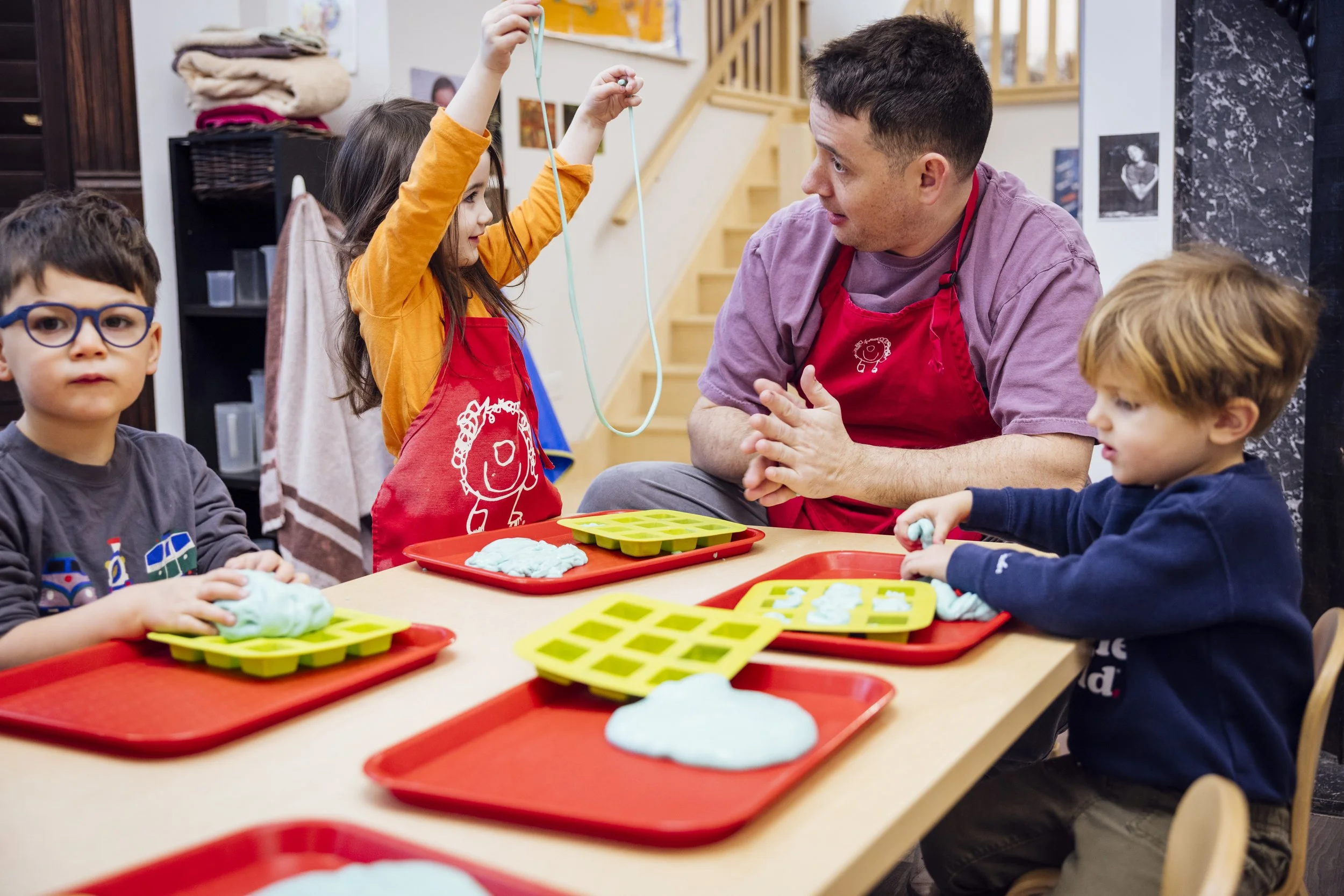
Many children have tried the variety of sensory materials offered – some materials are more familiar, like play dough, and children dig right in, whereas others, like kinetic sand and shaving cream, have entirely different properties and feature novel textures. Just as it is for us adults, gearing up to try something new can take time! Our independent thinkers are using their discerning judgment and observation skills to decide when and if they would like to engage in a new sensory experience. When (or if) they choose to engage, they are often delighted to impress designs upon playdough, or to create new color shades in shaving cream. They have been using their fine motor skills to squeeze the glue bottle in just the right place and then carefully place the next piece of tissue paper on the spot of glue. For those who discover they dislike the stickiness of glue on their hands, they are learning with experience that it can be easily wiped off or will simply dry quickly.

We recognize the children’s autonomy in small ways by honoring their choice to touch shaving cream and in how long they want to wash babies. In a world where children are permitted so few choices, school is a crucial space for them to make their own decisions!

We have noticed a common interest across our class: vehicles. To honor this interest we’ve created play spaces featuring trains, cars, trucks, and boats on the rug, atop the table by the window, in the gym, and in the sand and water tables. We even painted with cars a few weeks ago! Vehicle play offers children more than just a theme, however. We observe how the children have been working hard to hook trains together, connect train tracks and roads, identify road signs, and negotiate with the other drivers on the track/road.

Gym Time

Our sessions always begin in the gym, where the children can warm up to the environment and peers by using big body movements and through expressing emotion. The children have learned that the gym is a place where they can move their body in a unique way and try out new, often challenging, physical feats. They can build with big squishy blocks and lift them themselves! They can decide to go down the slide, try out the climbing wall, crash into the pillows, or scale the ladder. These are all bold opportunities in which children are utilizing their autonomy!

Group Time

During group time children are beginning to follow along with the motions of songs and now know that the Monkey first claps his hands and then cues a different action. They follow along and tap their toes, jump up and down, and wave goodbye at the end. They know what to do and they can show it! We also hear children make requests for specific songs, which signals to us their personal preferences about how we spend our time together.

At Home

At home your child may be picking out their own clothes, deciding which foods they do and do not want to try, and, of course, choosing what toys to play with. Although these may seem like small actions, they are promising signs of budding autonomy in your tot. We encourage you to give your child the space and time to flex that autonomy, and to say ‘yes’ when they want to wear the striped pants with the flower shirt. It often takes a little longer and can be a bit messier, but you will be helping to build their confidence and sense of self as they grow into a young person who is comfortable in their own skin and in expressing their own ideas.

You can also help boost your child’s sense of autonomy by giving them special ‘jobs’ to do to help out. Perhaps you might invite them to help wipe up spilled water or to pour the dog’s food in his dish at dinnertime. These simple but essential tasks bring children a sense of accomplishment and helps them to recognize that they are a valuable and interconnected member of the family whose contributions matter.

We can’t wait to see what your child discovers they can do on their own next and we look forward to helping them make more and more of those discoveries at school over the coming months.

Warmly,
Ashley & Kalei